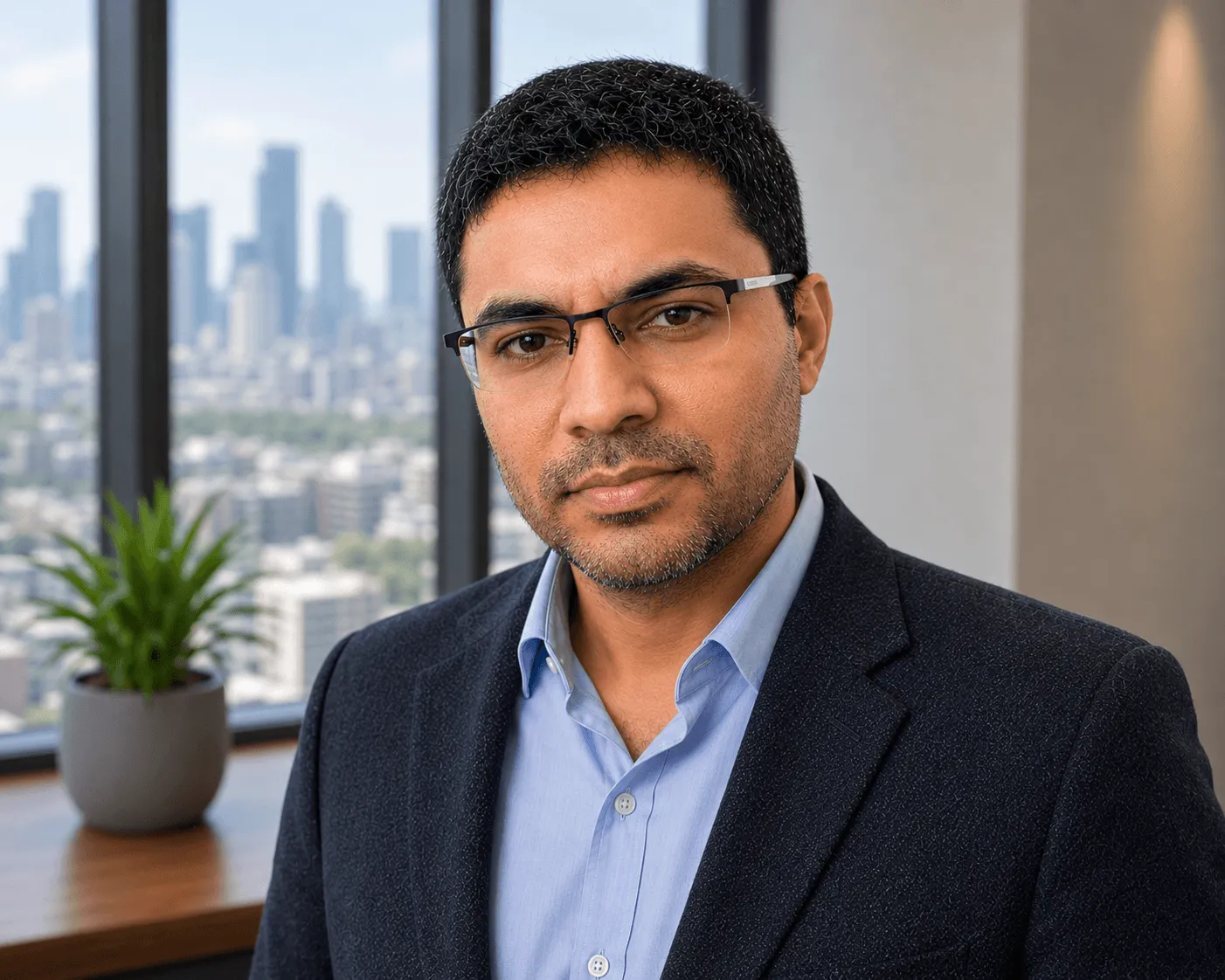
Engineering executive working at the intersection of commercial scale and the architecture
of trust. Builds category-defining technology for the digitally underserved — the users a
market reaches last, and the systems that decide about them.
Two halves of one practice: what a system does, and what it owes the person it decides
about. The current work is agentic governance — corrigibility, the right to contest what an automated system decides about you, before the systems
that decide are the only ones left.
Owns engineering for a global commerce platform across five countries: ordering,
marketplace, payments, billing, loyalty, restaurant operations, driver platforms, POS
and white-label SaaS, all multi-tenant. Inherited frequent critical incidents and made
predictable operations the norm without pausing delivery.
Regulated
Led engineering for an RBI-regulated lender: origination, underwriting, loan
management, collections, and the governance and risk platforms behind them, built in
house rather than bought. Lending-as-a-Service and co-lending orchestration integrated
with partner financial institutions.
Architecture
Payment systems, partner integrations and billing — the money path end to end, from
authorisation and settlement through taxation, invoicing and reconciliation, across
multi-tenant SaaS where every tenant has its own commercial terms. Designed around who
is allowed to do what, and who can prove it afterwards.
M&A
Technical due diligence on acquisition targets, then the integration: consolidating
overlapping platforms onto one stack without disturbing the customers or the revenue
running through them. Payment orchestration and reseller ecosystems carried across
intact.
Assurance
PCI DSS, GDPR and RBI obligations met as engineering practice, not paperwork: threat
modelling and OWASP discipline in the delivery path, zero trust between services,
audit trails that answer a regulator without a reconstruction exercise. Architectures
reviewed by regulators, boards and enterprise customers.
Transformation
Takes engineering organisations AI-native: agents in the delivery path, code and
organisational knowledge made machine-readable, and the governance that keeps both
auditable. Still reviews architecture and reads code.
Enabling the Indian language internet
2003 — 2016
Most of India's 22 official languages could not be rendered, typed or searched on a
computer. That is no longer true. Led the building of the layer that changed it, in the
open, over a decade — and 1.4 billion people came online in their own scripts.
Built it layer by layer, in the code as much as the plan. Desktop: typefaces, shaping
and input methods. Web: encoding, input and search. Mobile: conceived and shipped the
Indic Keyboard, under a
MeitY programme at ICFOSS. AI: corpora, then morphology, then speech — the data Indian
language models now train on. Credited in Firefox's about:credits; further
upstream contributions are
on GitHub.
Institutionalised SMC
and founded the
Indic Project —
the communities that built it. Both continue without me, which was the point.
Made binding
Member of the ICANN Neo-Brahmi Generation Panel, which decides which domain names are
permissible in nine scripts — the writing systems of more than a billion people.
Contributor to ECMAScript, Unicode and IDNA for universal acceptance and complex
script support. IS 16333 (Part 3) now makes Indian language support a condition of
sale for every device in India.
Reading a system for how it fails the people it decides about is the same discipline
that finds a failure mode before it becomes an incident — practised for fifteen years on
national infrastructure, where the stakes made it unavoidable. Software patents, opposed
at each attempt to widen the exclusion in Section 3(k) — 2006, 2009, 2012, 2015. Net
neutrality, when zero-rating was the wedge. And against the expansion of Aadhaar from
2010, then against its pandemic successors — petitioner in the Aarogya Setu case with
SFLC.in and HRLN, and against CoWIN as a precondition for vaccination. The docket is now
cited in legal scholarship on automated evidence. The
record is on the research page.
Contesting a system needs infrastructure of its own.
Moving Republic, a civic-tech startup he founded and ran until 2012, built it for public-interest
organisations across 18 states — their work moved onto the internet, on free software
and open standards, so none of it depended on a platform that could remove it.
Coordination that stayed secure under surveillance, documentation that held up as
evidence, tools that worked in many languages and poor connectivity. Civic tech before
the category had a name, for organisations the technology industry did not serve.
The Layer 8
Current
A publication on the institutional layer of computational systems — where standards,
identity, AI infrastructure, incentives and governance get encoded into infrastructure,
and what that encoding decides on everyone's behalf. Long-form essays, systems analysis
and architectural critique across enterprise AI, sovereign infrastructure, agentic
coordination and public systems.
Read it
Every essay is published on this site and sent to subscribers — the
archive is here, and the newsletter is at
layer8.anivar.net. Selected essays are syndicated to professional and public platforms.
Bio
Use as is
Take whichever length fits the programme. No approval needed.
One line · 36 words
Anivar A Aravind builds platforms that carry money, identity and language at global scale, and writes the standards deciding what those systems owe the people they act on. He is the author of the corrigibility framework.
Business · 154 words
Anivar A Aravind is Global Head of Engineering at Foodhub, where he owns the commerce platform behind restaurant brands and marketplaces across five countries — ordering, payments, billing, loyalty, restaurant operations and point of sale, multi-tenant end to end. He took that platform from frequent critical incidents to predictable operations without pausing delivery, and expanded it through acquisition, payment orchestration and reseller ecosystems. Before Foodhub he was SVP Engineering at Kinara Capital, building the lending stack in house for an RBI-regulated lender under PCI DSS, GDPR and RBI obligations. He now leads its move to AI-native delivery — agents in the delivery path, with the governance to keep it auditable. Across two decades and four industries the pattern holds: recognise which technology shifts endure, build the capability to act on them, and take the organisation through the change. He writes on the institutional and enterprise layer of technology and governance in The Layer 8.
Public interest · 132 words
An engineering executive, systems thinker and researcher, Anivar A Aravind works at the intersection of AI, governance and digital infrastructure. With over two decades across open technology ecosystems, internet governance, language technologies and public digital infrastructure, his work explores agentic governance, digital identity, computational institutions, and the frameworks needed to ensure accountability, legitimacy and human agency in increasingly autonomous systems. He is the author of the corrigibility framework — five structural tests for whether the people a system decides about can correct it — with the authorisation pieces written up as individual Internet-Drafts. He led the work that put Indian languages on the internet, and was petitioner in Anivar Aravind v. Ministry of Home Affairs, the Aarogya Setu case. In The Layer 8 he writes on the institutional layer of computational systems.
Extended · 290 words
Anivar A Aravind builds platforms that carry money, identity and language at global scale — and writes the standards deciding what those systems owe the people they act on. Two decades in, the pattern is consistent: he recognises which technology shifts endure, builds the capability to act on them, and gets organisations through the change with the governance and operational discipline enterprise systems require.
He leads global engineering organisations across commerce, payments and regulated finance — multi-tenant platforms spanning ordering, marketplace, billing, loyalty and point of sale; lending systems built in house for an RBI-regulated lender; acquisition diligence and the platform consolidation that follows it. He is Global Head of Engineering at Foodhub, and was previously SVP Engineering at Kinara Capital.
The other half of the work is the rules those systems answer to. He is the author of the corrigibility framework — five structural tests for whether the people a system decides about can correct it — has written the authorisation pieces up as individual Internet-Drafts, and writes The Layer 8, a publication on the institutional layer of computational systems.
Earlier he led the work that put Indian languages on the internet: typefaces and shaping, browser input and search, the Indic Keyboard under a Ministry of Electronics and Information Technology programme, and the corpora Indian language models now train on. He institutionalised Swathanthra Malayalam Computing, founded the Indic Project, and contributed to ECMAScript, Unicode, IDNA and IS 16333 (Part 3), which makes Indian language support a condition of sale for every device sold in India. He was petitioner in Anivar Aravind v. Ministry of Home Affairs, the Aarogya Setu case; the docket is cited in legal scholarship on automated evidence. He was named a Deccan Herald Changemaker in 2024.
Correspondence
Press enquiries, standards work and research correspondence:
ping@anivar.net.